The Future of Network Infrastructure
Software Defined Networking

Nowadays, many network devices are overkill. Networking vendors build devices that are very expensive with enormous features, but clients do not utilize those features optimally. Therefore, a new approach has emerged to address this problem called SDN, which stands for Software Defined Networking. This concept is built by making network functions programmable. It allows hardware to have minimum features so clients no longer need to invest in overspecified products. Besides that, SDN also offers other capabilities that can be powerful for modern infrastructure. Let us discuss how this technology is emerging.

Architecture
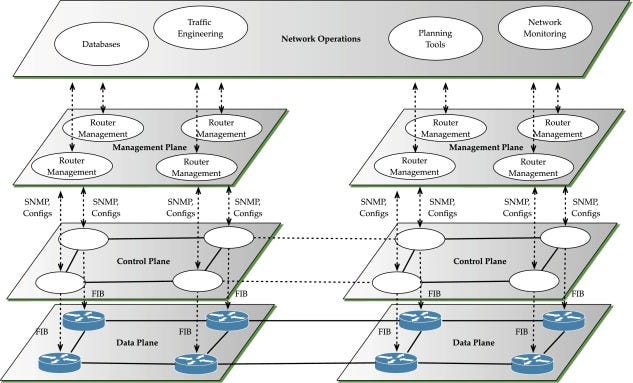
Software Defined Networking separates each function into 3 different layers.
Data Plane
This layer is responsible for forwarding packets from one device to another. When a packet enters the router, it checks the routing table to make a forwarding decision. After making that decision, it forwards or discards the packet accordingly ¹. This means the router no longer needs to handle routing decisions on its own, making it cheaper and more scalable to deploy.
Control Plane
This layer manages the routing of a network. It provides information about which path a packet needs to follow. It also handles the exchange of routing information and makes decisions such as what goes into the routing table. The control plane executes logic to create, manage, and populate routing tables ¹. This plane is mostly located centrally within the network.
Management Plane
This layer is a new feature in Software Defined Networking. While configuration is traditionally managed locally on each device, this layer makes it programmable. It authenticates anyone who tries to access the device, authorizes individual actions, and provides accounting features ¹. Usually each network vendor has its own dashboard to manage every device on the network.
Interface
In SDN there are 3 types of interfaces that connect the architecture together.
Northbound Interface
The northbound interface in SDN provides a standardized approach for communication between the highest application layer and the SDN controller at the middle control plane. It enables the efficient exchange of network information between the SDN controller and high level applications ³. This interface serves as the gateway between an application and the network system itself.
Southbound Interface
The southbound interface in SDN handles communication between the SDN controller at the middle control plane and the lower networking elements at the data plane ³. This communication happens between both planes to exchange information for transmitting data packets. As a result, the control plane receives populated data from the data plane and the data plane receives routing information from the control plane.
East-Westbound Interface
While the other interfaces connect different parts of the SDN architecture, this one is different. The east-westbound interface connects one controller to another controller. Its function is to provide a backup connection between controllers to maintain the reliability of the system. It replicates the configuration of one controller so that other controllers carry the same configuration. This way, when one controller goes down, the system can still keep running.
Protocol
Traditional networking typically uses protocols like OSPF, IS-IS, or BGP to route packets. In SDN, a new protocol is introduced called OpenFlow. OpenFlow is a network communication protocol used between controllers and forwarders in an SDN architecture. The OpenFlow architecture consists of a controller, an OpenFlow switch, and a secure channel. The OpenFlow controller is the brain of the SDN architecture and is located at the control layer to instruct data forwarding through the OpenFlow protocol. A secure channel is established between a controller and an OpenFlow switch, through which the controller manages the switch and receives feedback from it. As a core component of the OpenFlow network, an OpenFlow switch is mainly responsible for forwarding at the data layer and can be either a physical or virtualized switch or router ⁴.
Closing Thoughts
While SDN is already deployed in many places, most users still do not utilize the full capability of the technology. The programmability that SDN offers enhances the efficiency of engineers significantly. However, it comes at a cost in terms of domain knowledge. This happens because most network engineers built their fundamentals around command line interfaces with syntax notation. They need to shift this perspective toward a new domain of knowledge in order to maximize the potential of what SDN can offer.
References
Computer Networking Notes. “Data Plane, Control Plane and Management Plane.” Available at: https://www.computernetworkingnotes.com/ccna-study-guide/data-plane-control-plane-and-management-plane.html
Medhi, D., & Ramasamy, K. (2018). Networking and Network Routing: An Introduction. Network Routing, 2–29. Available at: https://doi.org/10.1016/B978-0-12-800737-2.00002-8
TechTarget. “Northbound Interface and Southbound Interface.” Available at: https://www.techtarget.com/whatis/definition/northbound-interface-southbound-interface
Huawei. “OpenFlow.” Available at: https://info.support.huawei.com/info-finder/encyclopedia/en/OpenFlow.html